


In June, I wrote about building the travel app I'd always wanted. I turned our family's messy travel doc into a pretty rad app (called Tripfold) that I came to depend on all summer. It kept all of our logistics, plans, booking barcodes and restaurant ideas in neat order on a pretty complex itinerary. I even had it make Gemini Notebook audio overviews with a history lesson about every place we visited. It’s pretty cool. But I’m not (just) here to brag about an app I built. I actually want to talk about something that making this app forced me to realize:
My app is never going to make enough money to justify building and paying for a custom agent in it. Yours won’t either.
On Friday, Ali Spittel on X explained it better than I ever could:

Ali is right. Users don't want to use your agent, they want to use the agent they’ve already set up and trust. As I write this, her tweet is sitting at 4.5K likes and 669K views, and the replies are full of people describing the exact shape I've been building toward. That's not vendors talking. That's users. The pull is coming from the demand side, which is the side that always wins.
The mistake everyone is making
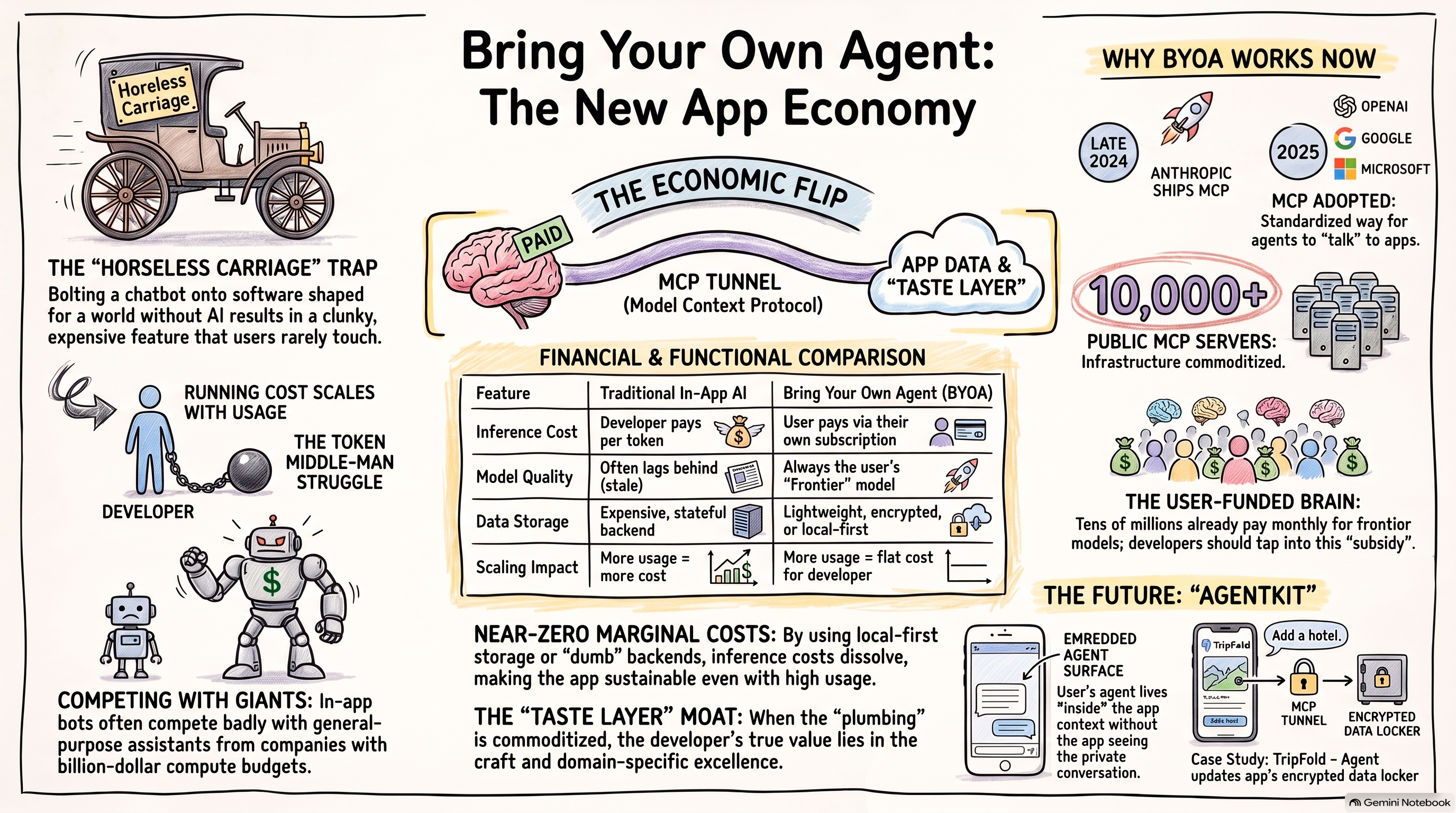
Say "add AI to your app" today and people reach for the same move: wire up a model, pay per token, bolt a chatbot into a corner that most users tap once and never open again. Pete Koomen has the sharpest name for what you get. A horseless carriage: AI bolted onto software still shaped for a world that didn't have it yet. And now you own a running cost that scales with usage, a model you have to keep current, and a feature that competes (badly) with the general-purpose assistants from the big boys.
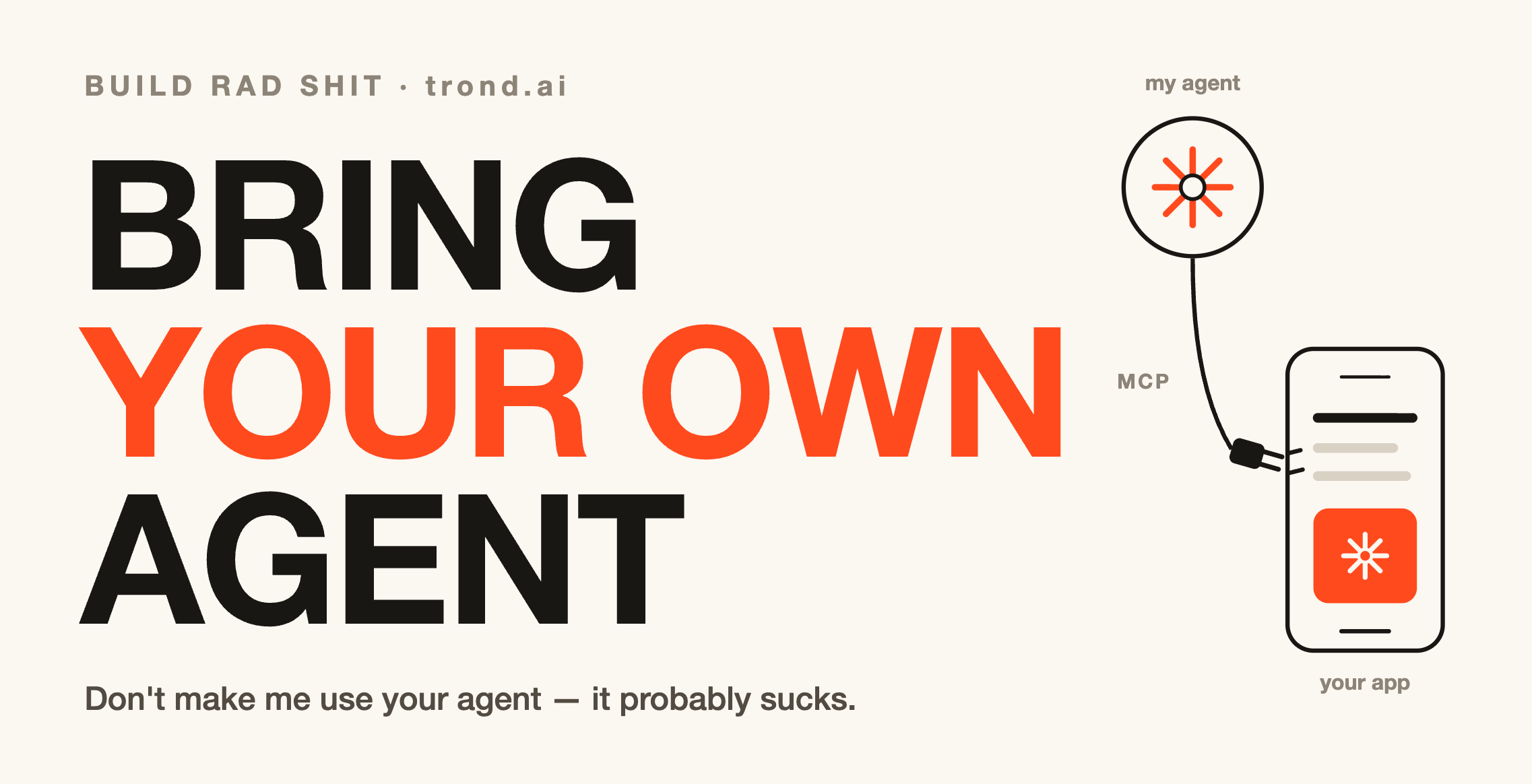
Your app is probably too small to do that. Don't put an agent inside your app. Let the user bring their own: the Claude or ChatGPT or Gemini subscription they're already paying for. It’s just better.
For many apps, adding an AI agent can be as simple as wiring up an MCP between your app and a host agent. The user points their assistant at the setup instructions, and forevermore their agent can operate your app. Your app, meanwhile, focuses on the one thing while enjoying the benefits of a powerful AI coworker.
Why it works now
This didn't work a year ago, but it does now because three important things changed.
The approach is standardized. MCP shipped out of Anthropic in late 2024. OpenAI adopted it in March 2025, and by that December it was handed to a Linux Foundation body that Anthropic, OpenAI, Google, Microsoft, and AWS all sit on. There are already north of 10,000 public MCP servers. And the plumbing an app used to invent for itself is getting absorbed into the protocol. All you need to do is implement it for your app.
The user already bought the brain. Tens of millions of people pay monthly for a capable assistant. That's a subsidy sitting around for you to use. Tap into that token flow, and every session starts with a frontier model that's already paid for, and fully up to speed on the user’s context. You get to build a great experience rather than figuring out how to survive as a token middle-man.
Free is better than paid. For many apps your backend can become dumb storage. For Tripfold, I found that a whole trip, every flight, hotel, and ticket, is about 250 KB encrypted. Serving that to a hundred thousand people a few times a day is a handful of gigabytes; on object storage with no egress fees, that's a couple of dollars a month. On CloudKit it's zero, because the bytes count against each user's own iCloud, not your bill. The expensive, stateful backend and strangling inference costs dissolve.
Stack those benefits up: near-zero marginal cost, no per-token bleed, a frontier-grade engine doing the work, and happier users. A pretty good deal.
The catch
Well, the most obvious issue is you’ve now invited a 3rd party into your user relationship. For users this may become a positive, but for most developers and investors it’s a total non-starter. If your onboarding experience asks users which agent they prefer, you’re becoming a distribution surface for those providers as much as anything else. It might be a revenue opportunity, but it’s surely smaller than the home run of owning the whole user experience.
As the barriers to building apps collapse, we’re seeing a flood of new apps. Almost none of these are going to get distribution and even fewer will be able to eke out a real business on top of buying tokens. Developers who don’t want to subsidize the growth phase either need to move the inference for these experiences onto devices or bundle it into agents a user already pays for. The economics just won’t work otherwise.
As this shift starts accelerating, notice where the moat ends up. The plumbing (the queue, the auth, the sync) is commoditizing; the platform giants are racing to own inference, and agent relationships will increasingly depend on deep cross-domain context that’s hard to do sub-scale. What doesn't commoditize is the taste layer: the craft that makes a generic agent do amazing work on your specific domain. Build your moat there. Rent the rest.
What flips with this approach?
When you stop competing on model quality, which is a race you'd lose to companies with billion-dollar compute budgets, and start competing on the surface and the trust layer, you give yourself a real opportunity to win. That's the exact ground where a small team can be the best in the world at one thing.
The economics flip too. The default mode of AI software right now is "usage costs you money." This is the opposite. A user who leans on their agent harder makes their provider money, not you poorer. Your costs sit flat near zero whether someone opens the app once a year or every single day.
It's not for everything. Someone without an agent just gets a very well-made offline app; no worse off, just no magic. This is a pattern for apps whose users increasingly walk around with an assistant already in their pocket, holding data that deserves a permanent home instead of a chat log that scrolls away.
I'm not the only one seeing this
Straight up, I didn't coin this. "Bring your own agent" is already a phrase people are reaching for, mostly on the enterprise side. Luke Turner made the SaaS version of the case: stop shipping mediocre in-app AI that competes with your users' state-of-the-art agents, and build the MCP surface that lets those agents drive your product instead. Same instinct as bring-your-own-device a decade ago, just aimed at intelligence instead of hardware.
It's got good company. Koomen's horseless-carriage piece is the same fight from the app side. And Geoffrey Litt and the Ink & Switch crew have spent years on malleable, local-first software: tools you reshape yourself, your data living with you instead of in someone's cloud. The whole intellectual foundation this stands on.
When will we get AgentKit?
There’s a massive missing piece to this puzzle, and I think it's where this goes next. Because it kind of sucks to have to open a different app to do something in your app. I mean users will hate that. Today’s pattern runs agent-on-the-outside. Your assistant lives in its own app, reaches into mine over MCP, and the work lands on my phone. Useful, but the conversation and the app are still two places, which is gross.
Compare that to how every iOS app shows you a web page. Nobody builds a browser. They embed WebKit: Apple's whole browser engine, running inside a third-party app, and the host app sees only what the API hands back. It has access to passwords, saved context and everything their Safari browser can do. I expect them (and others) to run that same move on agents next.
In that world, a developer drops an encapsulated agent surface into their app. I open Tripfold and talk to Gemini right there, on a dedicated surface, in the context of the trip on screen. And it is genuinely my agent: the one that knows me, with its memories, its connectors, the skills it's picked up across everything else I do with it. The host app can't read that conversation. All it gets is what crosses the tunnel we pre-agreed on, which is exactly the skill and MCP surface the app published in the first place. The dependency points one way. (WebKit doesn't get to read your Safari history either. Same deal.)
Everyone at that table has a reason to want it. Developers get an assistant in-context that already knows the user, without shipping a model or eating a token bill. Users get one agent with one memory everywhere, instead of eleven amnesiac chatbots in eleven corners of eleven apps. And the agent companies might want it most of all: they are competing brutally for distribution right now, and "your agent, present inside every app you use" is distribution. WebKit made every app a browser without every developer building one. The same move makes every app agentic without every developer shipping an AI.
The skill-and-MCP surface I built for Tripfold is the tunnel half of that story. The embedded surface is the half I'd love to see an agent platform ship.
Wait, what’s Tripfold?

Tripfold is the app I built using this approach. It holds your itinerary (flights, hotels, tickets with their real scannable barcodes, all the little logistics that matter when you’re standing in a train station in a country whose language you don’t speak) on your phone and stores data either offline or online, encrypted. You don’t plan the trip in the app. You tell your own agent “add two nights in Verona, here’s the confirmation email,” it assembles the entry, the MCP rules check the validity, it publishes the update to an online storage locker and in seconds it shows up on your phone with a note about where it came from.
I built the travel app for me and my family, but I’m happy to share the TestFlight build in case you want to try it. The pattern under it (the MCP, encrypted locker, and the bring-your-own-agent wiring) is the useful part, and I’m open sourcing it. I call that portion tripkit. It’s one small example of how you can build an app to allow any stranger’s agent to safely construct your app’s data. Take it, change it, morph it to be your own. Point your own agent at your own problem.
And as of this week, Tripfold itself is in public beta on TestFlight. Download the tripkit skills to your agent and you’ll be on your way!
I'm building one of these in the open, and the beta is live. Install Tripfold from trond.studio/tripfold, point your agent at a trip, and hit reply with what breaks or what you're building next to it. I read everything.