


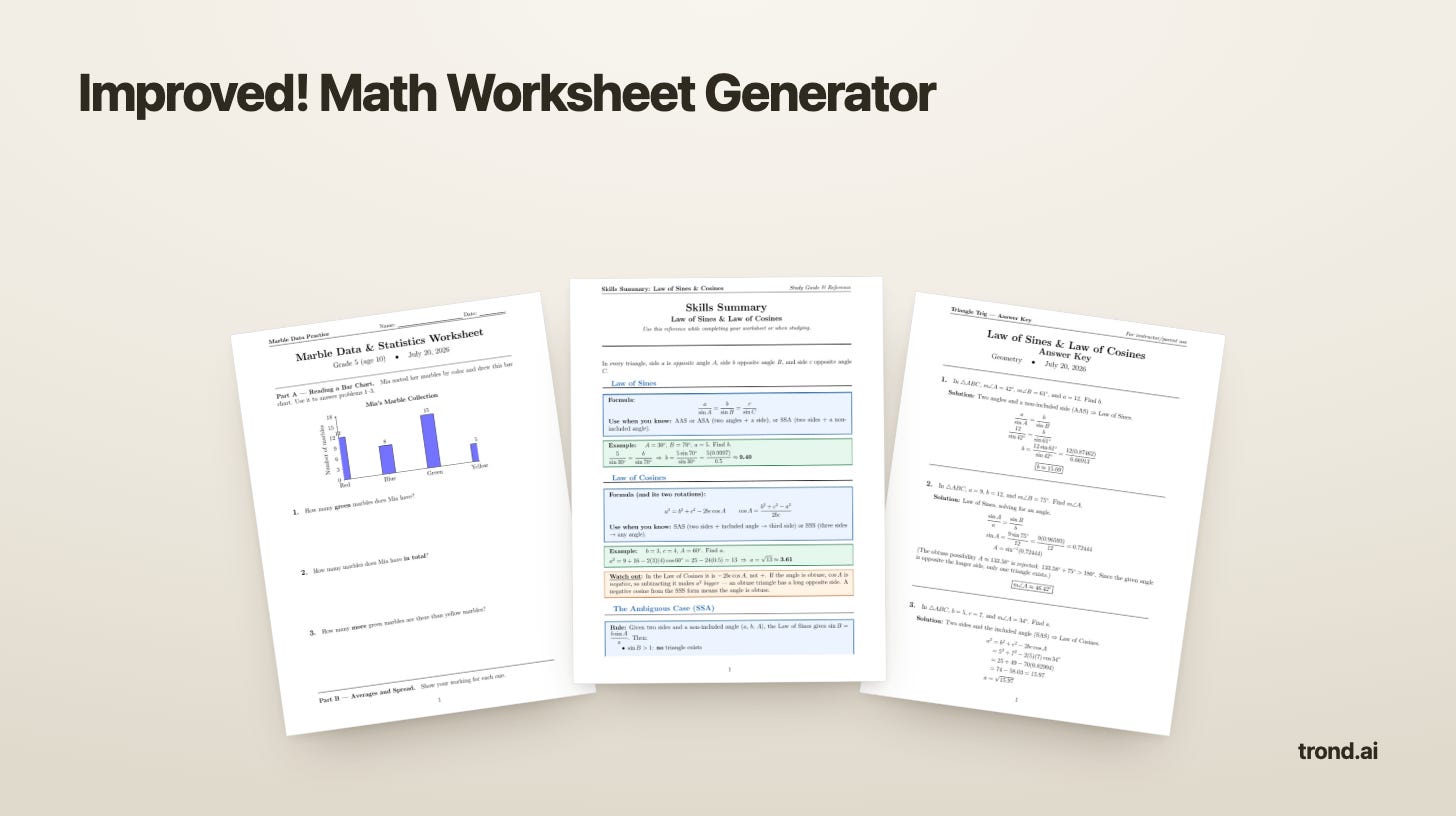
I spent eight years handwriting math worksheets for my kids before I built a tool to do it for me. That tool was good. Every worksheet I ever handed my kids was correct, and I'd grown to trust it for the day-to-day math practice they needed.
But a new school year is coming, and both my kids are on an advanced math track. My son is starting 10th grade and is on pace to take Calc BC by senior year. My daughter starts 8th grade on a similar path. I wanted the worksheet tool to grow along with them and cover algebra, geometry, trig, word problems, and eventually calculus. Basically the whole math curriculum through high school.
That's a much bigger surface area than what the first version of my tool covered, and it changed what I needed it to do. The system needed to cover hundreds of new problem types I hadn't yet tested. I didn't just want to expand the scope and hope it kept working. I wanted to raise the bar, so when it takes on a new corner of the curriculum I can prove it's right rather than merely assume so.
So I rebuilt it last week. The new version does several important new things.
Works with your favorite AI agent
The old version was built for OpenClaw, which is great for me but a bunch of people told me they had no idea what that is. More people have access to a tool like Gemini, ChatGPT or Claude, so I fixed the limitation.
The rewrite is packaged as a skill: a folder with a SKILL.md file, some reference material, and a verification script any coding tool can load. Claude Code, Gemini, and Codex all standardize on this instruction format, which is nice. There's no per-tool version to maintain because there's only one skill, and it works out the local environment on its own (which LaTeX engine is installed, what model config is present) instead of assuming a particular configuration.
Thoroughly checks the answers
The model still writes the problems and proposes answers. But now before anything gets rendered, every answer is checked against SymPy, an actual computer algebra system, the same class of engine that sits under Mathematica. If SymPy can't confirm the answer, we rework the problem.
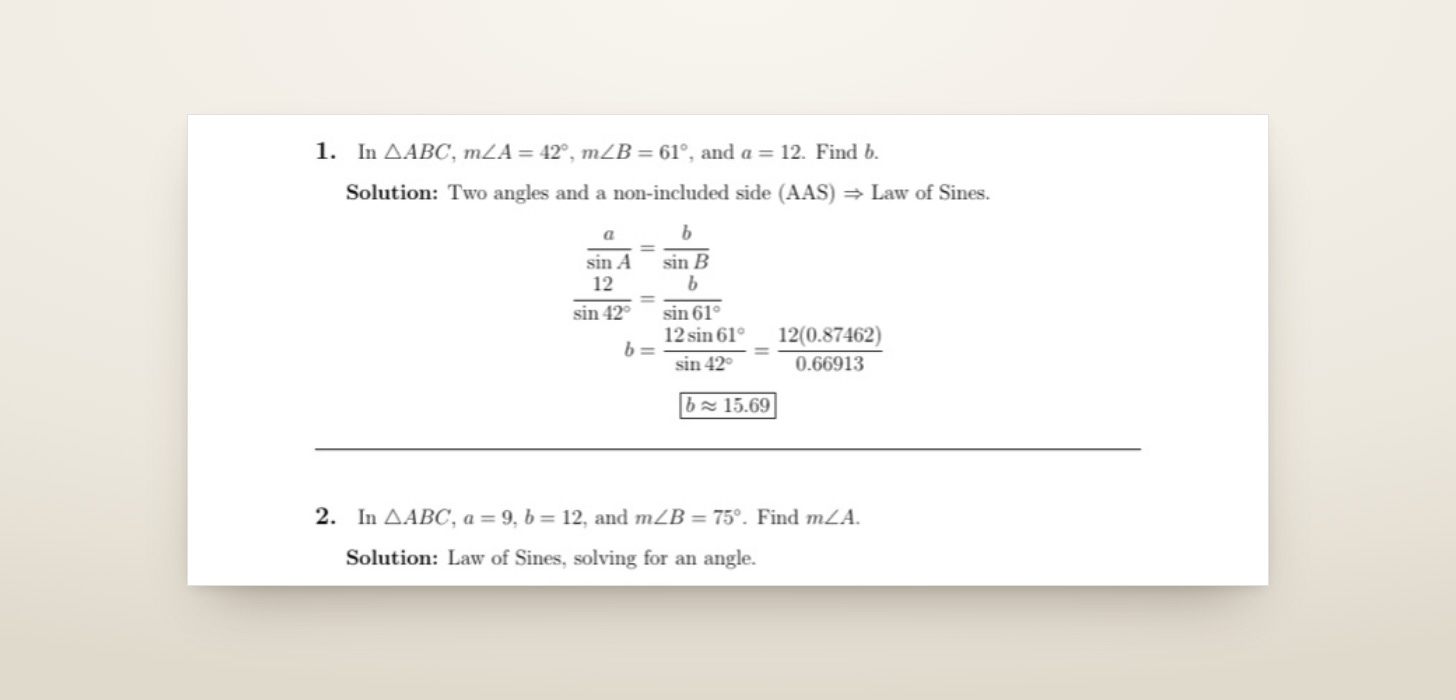
There are 24 specific verification types, because "check the answer" means something different depending on the problem. For example:
Solving an equation over the set of real numbers is not the same as solving it over the set of complex numbers.
A definite integral gets confirmed symbolically when SymPy can do it exactly, and falls back to convergence-checked numerical quadrature when it can't. If that doesn't converge, the problem is flagged for review.
Triangles get the law of sines and cosines, including the ambiguous SSA case.
Statistics, probability, limits, series, systems of equations, reading a value off a chart: each has its own checker, and each has its own idea of what "correct" answers look like.
Passes comprehensive evaluation
Next, I challenged the answer system with real problem sets. Every step in the GSM8K collection of grade-school word problems and every boxed answer I could pull out of a public dataset of competition math problems went through the verifier. I evaluated 4,282 checks from the first set and 2,711 from the second. Just under 7,000 checks in total and across the eval set we hit zero false positive results.
It seemed too good to be true, so I went looking for trouble. I ran two rounds of adversarial audits against my own verifier, hunting for cases where it might confirm something false as I stretched it into harder math. Both rounds found real problems, and the second surfaced eight subtle issues at the edges of the new coverage, including:
The definite-integral checker was using a quadrature method that gave wrong values on oscillatory integrands.
The interval solver couldn't see tangent roots, the places where a curve kisses the x-axis without crossing.
The system-of-equations checker would accept a solution that satisfied only one branch.
The probability checker didn't confirm that a probability landed between 0 and 1.
These are exactly the failure modes you'd never notice by eye on an advanced worksheet, which is the whole point of having a machine check them. I fixed all eight and pinned each fix with a regression test, so they can't come back. I haven't been able to find others, but you never know.
Ready for any grade level
Correct answers are the minimum bar. A worksheet also has to be the right worksheet: the right concept, at the right level, for where the kid actually is.
So all problems are now mapped to real curriculum standards. Common Core codes for K-12, and the AP Course and Exam Description for the calculus track. Each concept carries a difficulty rating from 1 to 5 and a Bloom's-taxonomy tag for cognitive level, so "quadratics" can mean plug into the formula or derive the discriminant condition depending on what you ask for.
To find coverage gaps, I ran the whole thing against the Marble team's open taxonomy of what students learn.
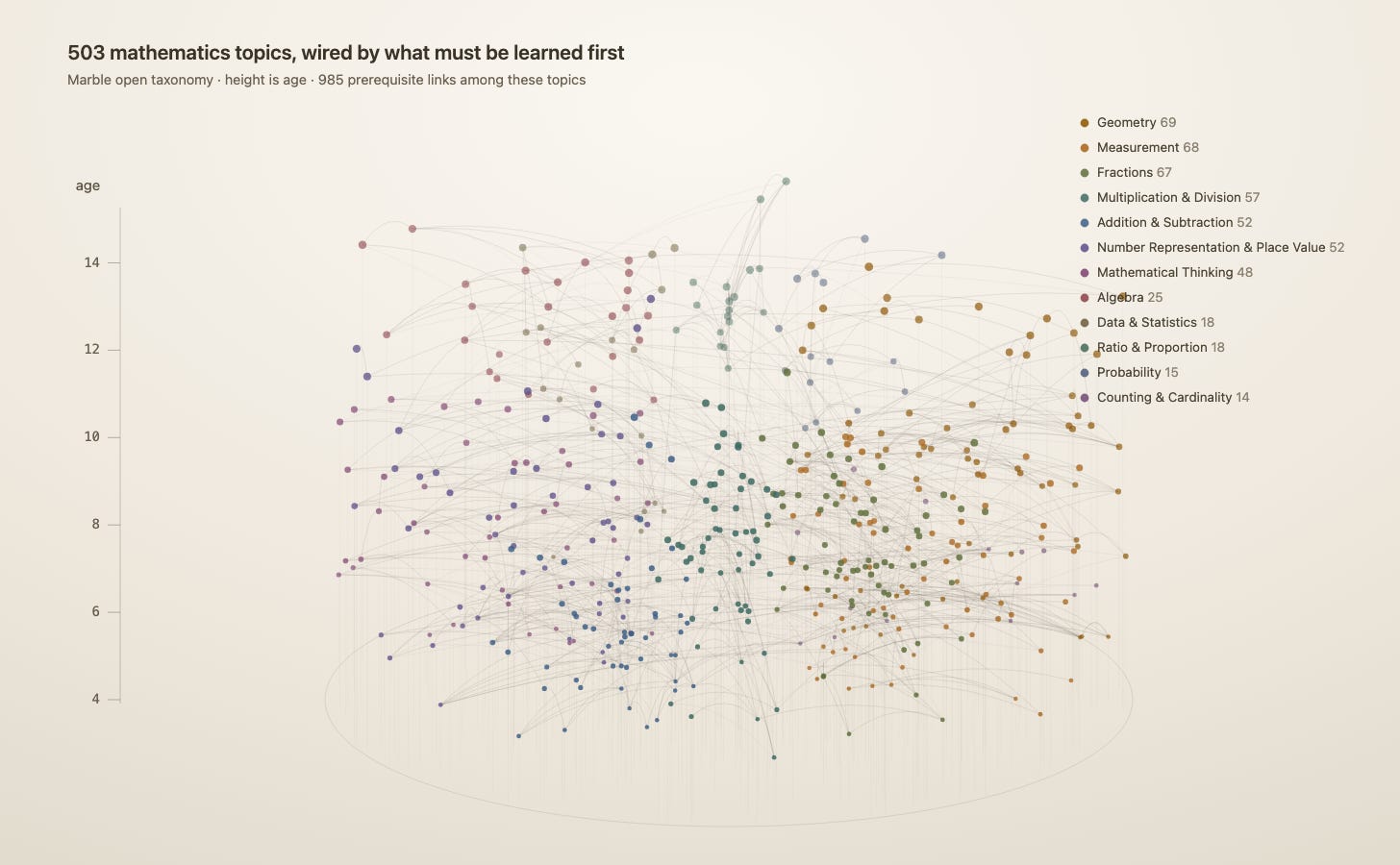
About 40% of that taxonomy isn't machine-verifiable. "Write a story problem about sharing" has no single right answer a computer algebra system can confirm. The tool doesn't pretend otherwise. It knows which problems it can prove and which it can't, and it says so instead of dressing up a guess we check the result.
Keeping the system healthy
Finally, I implemented a robust regression and code quality test system to make sure any future changes don't re-introduce a problem we've solved before.
The suite covers 91% of the code, and continuous integration blocks any change that drops it below 90%. Every audit finding has a dedicated test, and every verification type ships with fixtures that must pass before I make a software update. Whether the thing that checks correctness is itself correct isn't a matter of my confidence. It's measured every time I make a code change to this system. The safety net allows me to add curriculum coverage without wondering whether I broke the system.
Ready for you
The updated math worksheet generation tool can now create worksheets for math topics from counting through calculus, and ready for the school year ahead. The whole thing is open source, and the verification layer is included. The system is honest about what it can and can't prove. It tells you when it's sure, and when it isn't, and it holds that line even as the math gets harder.
Download the skill: github.com/stellawuellner/math-worksheets-skill