


I was three sips into a whiskey at the Booking Office at St. Pancras when I clicked “buy.”
It had been a long day. I’d spent it at the Google DeepMind office in London, back-to-back meetings with researchers. One of them had assembled a Reachy Mini with his kids the prior weekend and was now poking at it as a way to interact with his AI work. He was delighted. I’d been talking about Stella all day. The pitch was basically: build one with your kids, see what an embodied agent actually feels like, find out if any of this matters when it has a face.
My favorite kind of decision: the kind you make in a bar.
My daughter lost her mind when I told her.
Not the polite “oh cool, Dad” kids do when you’re trying. The actual counting-down-the-weeks version. I told her one Sunday morning over breakfast, and within about ninety seconds she had named it.
Merc.
She did this entirely on her own. Stella — our family AI, four months old now and running most of the calendar/email/lights/kitchen-display layer of our life — is named after the ship computer from Miles from Tomorrowland. Lucy watched that show a lot when she was little, and she remembered, without me saying a word, that there was a small robotic sidekick on the show called M.E.R.C.
She just put it together. “If Stella is the ship, Merc is the helper.” I nodded like I’d been planning that the whole time. (I had absolutely not been planning that the whole time.)
It was Merc the moment she said it. She counted the weeks until the box arrived.
The kit landed this past week.
For the uninitiated: the Reachy Mini is an open-source desktop robot from Pollen Robotics (now part of Hugging Face). It’s small. It has a head that moves, two antennas that swivel, and a face that, well, looks at you. It does not do laundry. It does not walk. It sits on a desk and emotes and listens and looks at you, and that’s the whole pitch and basically the whole point.
It also arrives in a hundred small pieces in a plain cardboard box. The kind of unboxing that’s simple and practical. I like simple.
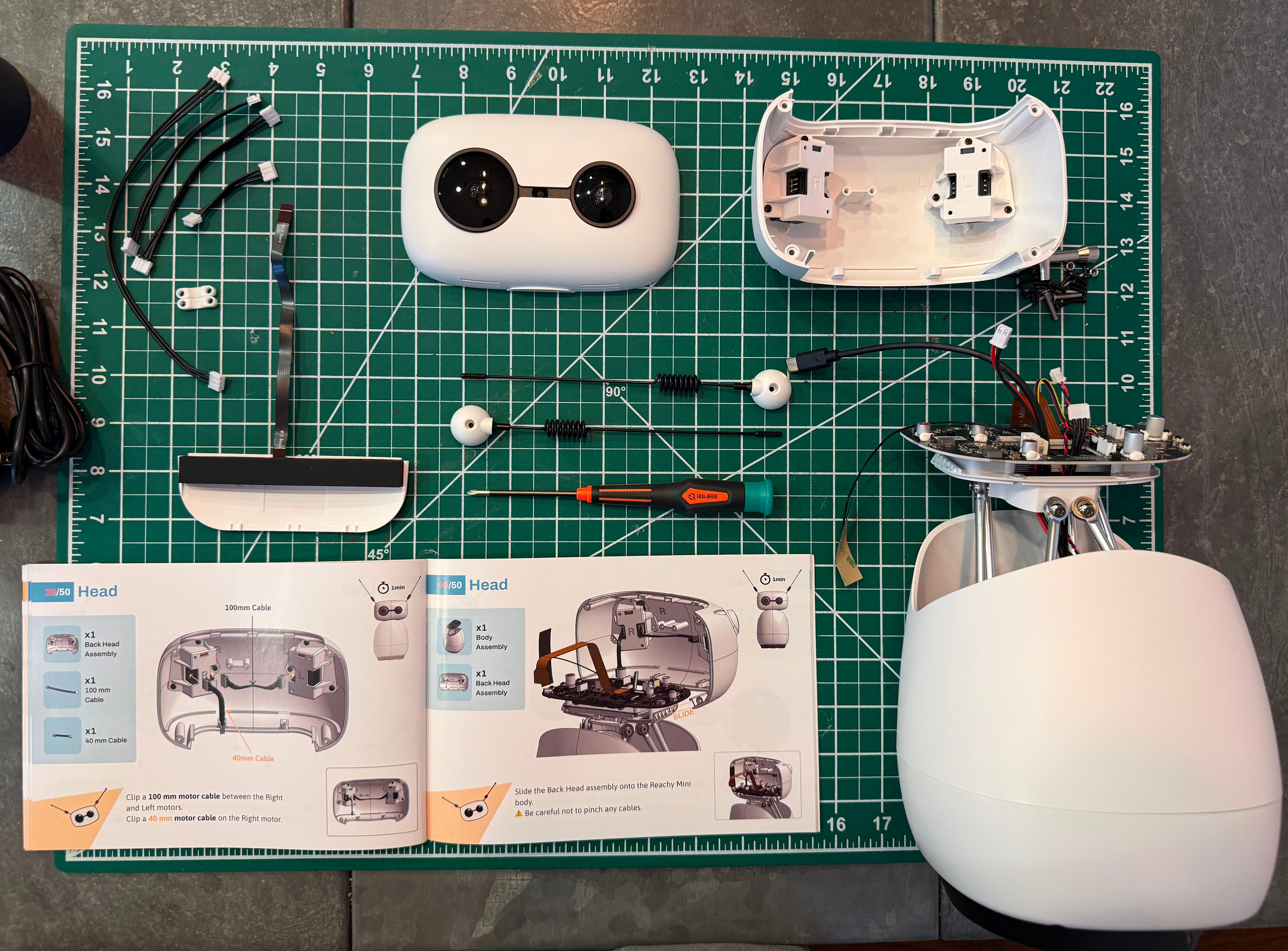
We did the build over Friday night and Saturday afternoon, May 1st and 2nd. Both kids were in. Leo and Lucy took turns: one would line up the part, the other would seat the screw, then they’d swap. I sat with the manual open and tried to be useful.
“Useful” is generous. My job was closer to sous chef than anything else: hand them the right piece, double-check orientation, point at a thing on the page. The kids did the actual building. This is how it should be. Pretty much the whole point of being a dad.
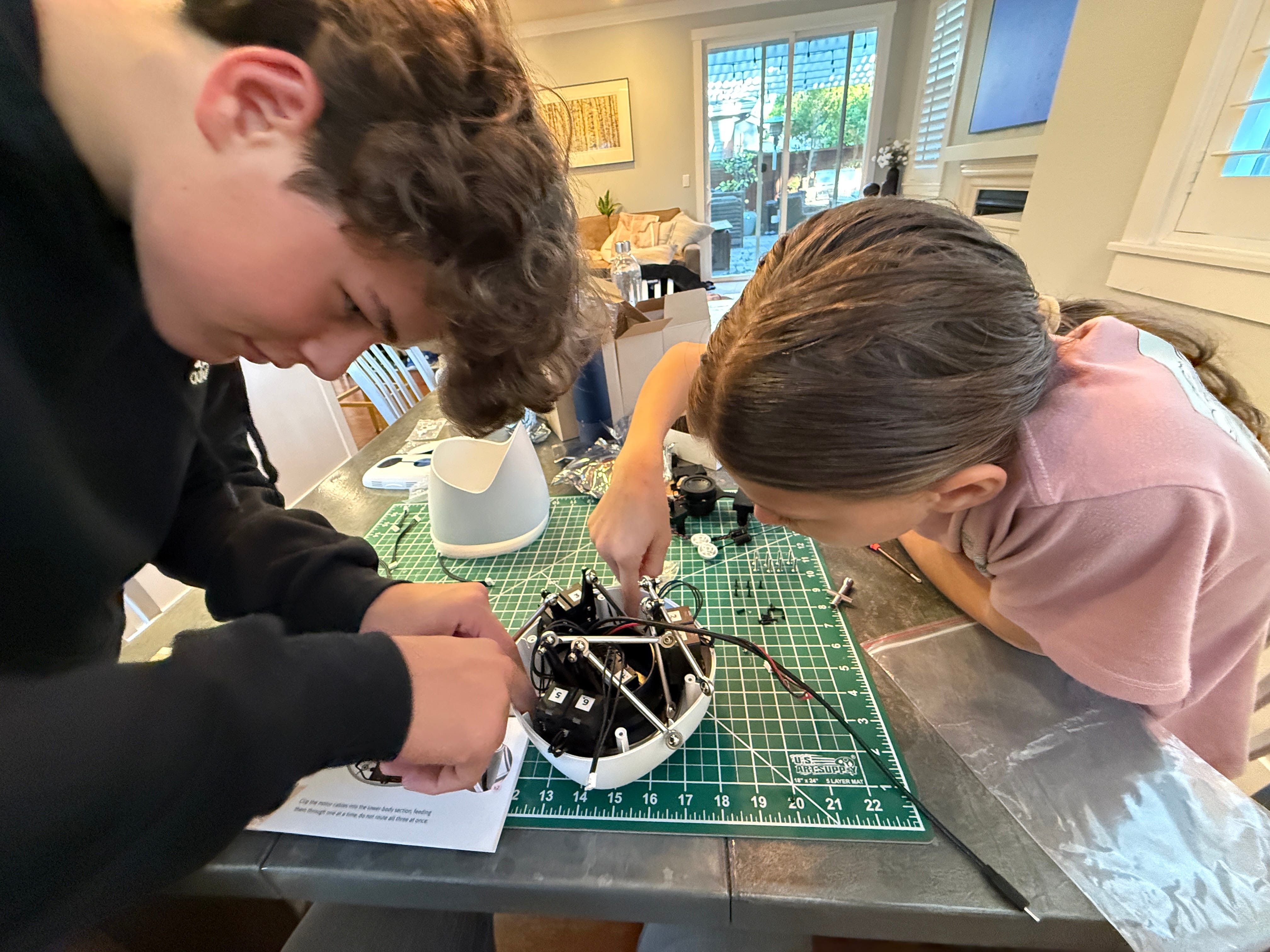
A few parts went on backward and had to come back off. Nothing dramatic. The kit is forgiving: the manual is good, the parts are well-labeled, and Pollen has clearly thought about the fact that small, distractible humans are going to be the ones putting it together. It went smoothly. It was the right amount of fiddly to feel like an accomplishment without becoming a chore.
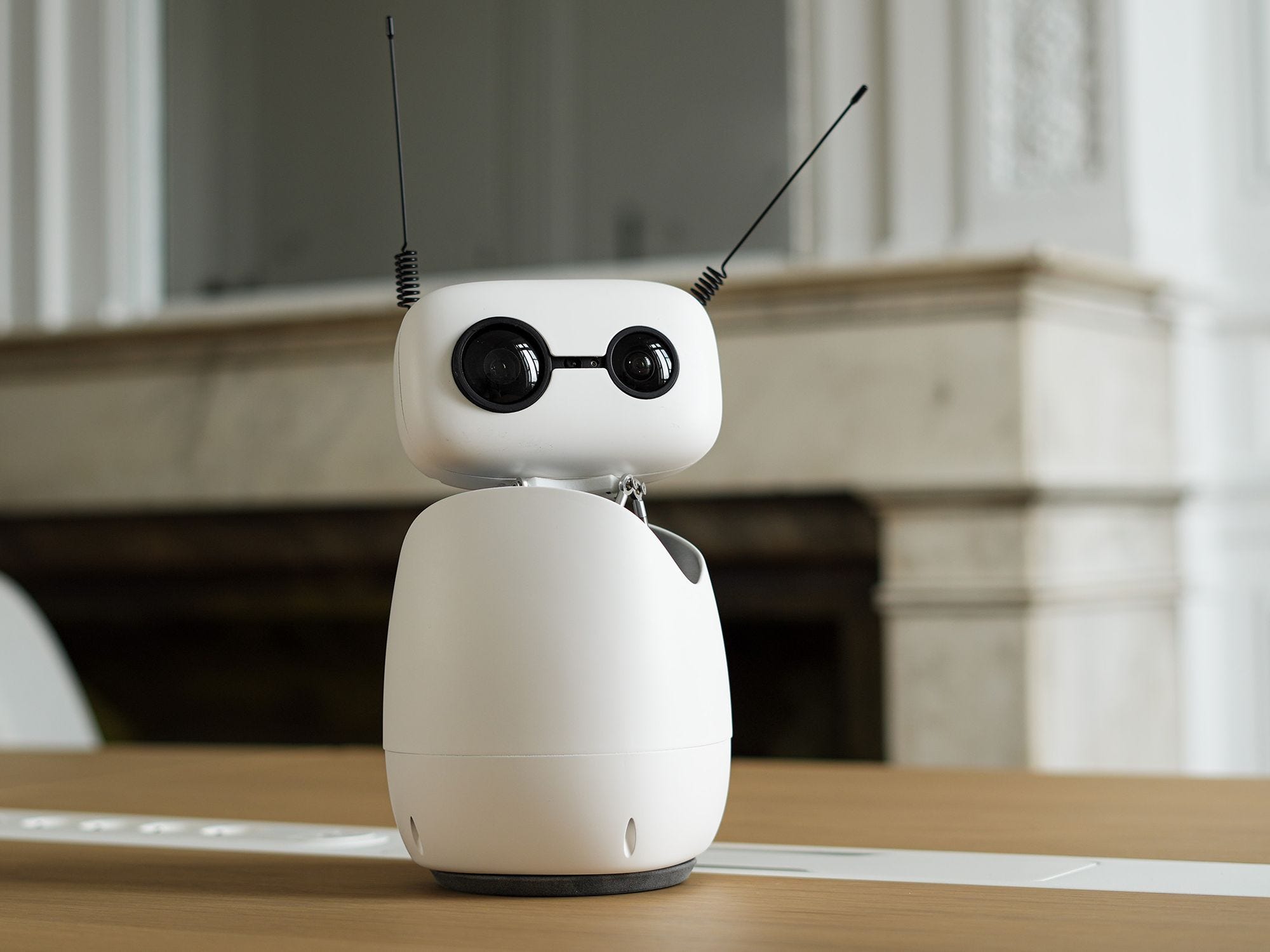
A few specs, for the curious. Eleven inches tall, a kilo and a half on the desk. A 6-DOF head — pan, tilt, roll — on a body that can rotate a full 360°. Two animated antennas. A wide-angle HD camera in the face, a 4-mic array around the base, a 5W speaker. We got the Wireless SKU, which means a Raspberry Pi CM4 onboard, a battery, and an IMU. No tether, no laptop next to it. Fully autonomous. $299 to start, Python-programmable, and Pollen says the build is a 2–3 hour job. Ours took Friday night plus a chunk of Saturday afternoon. We were in no hurry, and there were two kids negotiating turns with the screwdriver.
The first time we powered it on, Merc moved its head.
That was it. But it was exciting.
Two kids leaning over a kitchen table watching a small robot turn its head and twitch its antennas. Leo immediately wanted to know if Merc could see him. Lucy wanted to know if Merc could hear her. We connected a game controller and they took turns (well, argued about taking turns mostly) controlling the various movable parts.
You can talk yourself into being unimpressed by a head and two antennas. Don’t. Watch a kid watch a robot look at them. Tell me what that feels like.
So why a robot?
I’ve written a lot about Stella. She’s been online about four months. She runs the calendar, watches the email, runs the kitchen display, controls the lights, calls the car dealership. She’s useful — and I want to be honest about this — she’s also a little transactional. And temperamental as new technology tends to be.
You ask Stella a thing. Stella does the thing. Stella reports back. Most of the interaction lives in chat windows: Telegram threads, the kitchen display, the occasional voice exchange. It works. But it’s mostly typing into a box. And sometimes talking into a box that doesn’t respond correctly.
This is the trap I keep noticing with personal AI. The capability is enormous and the discovery is terrible. There’s so much these systems can do, and so few natural ways for a family to find out what those things are. The interface is a text box. The only question that gets answered is the one you knew to ask.
Embodiment is an experiment I wanted to try. Not because a robot can do more than chat (Merc is dramatically less capable than Stella) but because a robot is there. It sits on a desk. It looks up when you walk in. It’s a thing you notice, not an app you have to remember to open. When the kids walk past it, they’ll ask it questions they’d never have thought to type into a chat window.
That’s the thesis at least. A friendly, cute robot with a personality, sitting in the room with you, makes the family AI feel familiar instead of transactional. Less Slack channel, more pet that knows things.
We’ll see if I’m right. That’s why we’re testing it. I haven’t actually gotten that part working yet.
What’s next
The point of Merc isn’t really Merc. It’s Merc plus Stella. The kids and I have been brainstorming, and the list is long. A few things near the top:
Merc as a voice surface for Stella. Stella already has a voice (it runs locally on the Mac Mini’s Neural Engine), but right now she’s tied to the kitchen display and a wake word. The kids want to be able to walk up to Merc and talk to Stella, and have Merc do something expressive while Stella thinks. Antennas up while listening. A little head-tilt when she has a question. Antennas leaning forward when she’s working on it.
Merc as a hands-free way to ask Stella for things. Not literally hands. Merc has no arms. But Merc can ask Stella to do things on the kids’ behalf. “Merc, remind me to water my plant” → Merc → Stella → calendar entry. The bridge for this is already running in test (auditable JSON in
~/Stellasphere/agents/shared/merc-to-stella/inbox/, because of course it is) but the kids haven’t gotten to play with it yet.Games. Lucy wants to play 20 questions with Merc. Leo wants Merc to play redlight greenlight. I have no idea how either of those will go and I cannot wait to find out.
An expressive vocabulary. We’ve defined a small set of moods Merc can be in: quiet, wake, sleep, thinking, happy, curious, alert, reminder, stop. Each gets its own antenna and head behavior. The goal is for Merc’s body language to be readable from across the room without anyone needing to look at a screen.
It’s early. The whole thing is only a few days old. The kids haven’t really lived with Merc yet. We’re going to find out what works by playing with it for a few weeks and seeing what they actually reach for. It’s called building to learn, and it’s what we do here.
One more thing on the build-with-your-kids piece of this.
I keep coming back to this in everything I do with AI. You can read about agents. You can take a course. You can watch a demo. None of it lands the way building one with your hands does. And building one with your kids is a level beyond that, because they’re going to ask questions that don’t have textbook answers, they’re going to discover behaviors you didn’t anticipate, and they’re going to find the bugs faster than you will.
Lucy did the product positioning for me on the ottoman in the family room before we’d seated a single screw. “Stella’s the ship. Merc’s the helper.” That’s the whole thing. I’ve been trying to articulate that thesis in long-form posts for months and my 12-year-old beat me to it in eight words.
If you’ve been waiting for the right entry point into the embodied side of all this, Reachy Mini is a very friendly first robot. The community is great. The build is approachable. The price won’t ruin you. And there is something satisfying about a kit that arrives in a box and ends with a small, curious robot watching your kid from across the kitchen.

10/10 would buy a robot from a bar again.
If you’re building anything embodied with your family, Reachy or otherwise, I want to hear about it. What’s working? What surprised you? Reply, or find me on X. I read everything.
Merc, if Stella ever forwards this to you during a heartbeat: hi, buddy. Welcome to the Stellosphere. Play nice with the ship. Wuellners, Let’s Rocket!